
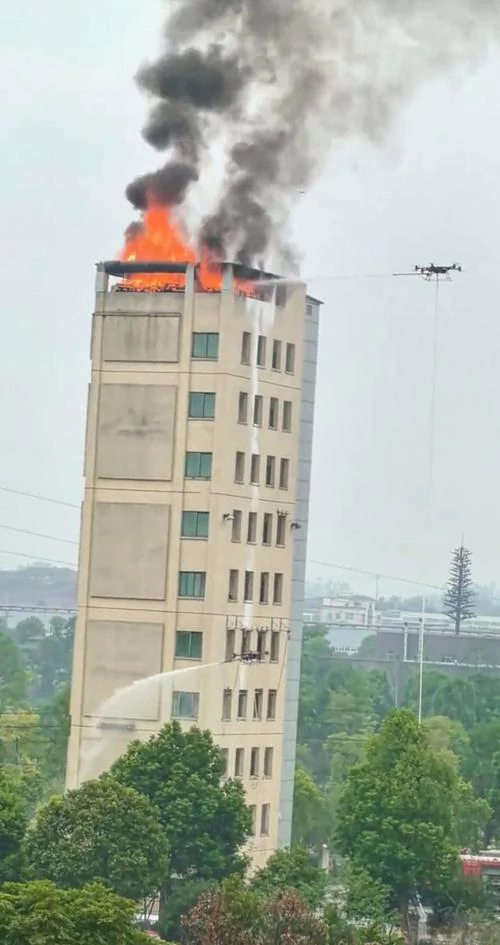

High Rise Building Fire Fighting

Fast, safe, and mission-ready support for high-rise firefighting when ladders, elevators, and human access fall short.

high rise building fire fighting

High-Rise Fire

High-rise building fire fighting has always been constrained by ground-based equipment and human access:

  • Slow vertical access
    Aerial ladder trucks require positioning space and setup time. In dense urban streets, reaching upper floors can take several minutes—often beyond the critical early response window.
  • Limited reach and angles
    Even the largest aerial ladders are typically limited to around 100 ft (≈30 m). Upper floors, set-back façades, and internal fire spread are often beyond direct reach.
  • High risk to firefighters
    Entering a burning high-rise without full situational awareness exposes crews to flashover, structural failure, smoke conditions, and unknown interior fire paths.
  • Uncertain victim locations
    Without real-time views of upper floors, locating trapped occupants, blocked stairwells, or compromised corridors becomes a race against time with limited information.


These limitations are exactly where unmanned aerial systems add value—not by replacing ladders and elevators, but by extending what is possible in the first crucial minutes.

How UAVs Support High-Rise Building Fire Fighting

VANTA BOTICS high-rise building fire fighting solutions are built around one objective:
give incident commanders fast, risk-free, high-angle access to information and suppression options.

Rapid Access

UAVs reach upper floors within seconds, bypassing traffic, blocked streets, and elevator delays to give incident command immediate vertical visibility.

Clear Intelligence

Thermal and optical sensors identify fire origin, hotspots, victims, and structural conditions through windows or openings for informed tactical decisions.

Remote Intervention

Launch modules and heavy-lift configurations enable targeted suppressant deployment and delivery of critical tools without exposing crews to interior hazards.

Aligned with Public Safety UAV Practice

VANTA BOTICS designs its high-rise building fire fighting concepts in line with recognized public safety UAS practices, including the principles found in NFPA 2400 for public safety UAS programs.

Thermal Intelligence

High-resolution thermal imaging to identify fire origin, hotspots, heat migration paths, and potential structural compromise on upper floors.

Aerial Entry and Inspection

Agile platforms capable of approaching windows, balconies, and structural openings to capture close-range optical and thermal data from inside affected floors.

Heavy-Lift Mission Platforms

UAVs configured for higher payload classes (e.g., 100–300 kg, depending on configuration) to carry tools, supplies, or specialized rescue support equipment to upper levels.

High-rise building fire fighting demands tools that keep pace with vertical growth and urban complexity.

If your department is exploring UAV support for high-rise operations, our engineering team can help you define payloads, flight behaviors, and deployment concepts tailored to your building stock and response procedures.

Why UAVs Complement Traditional High-Rise Firefighting

UAVs are not a replacement for ladders, standpipes, or interior crews. They are a force multiplier.

  • Compared to ladder trucks
    Ladders require street access, setup time, and are height-limited. UAVs launch from tight spaces, reach upper floors quickly, and can work around obstructions.
  • Compared to fire elevators
    Elevators are often unsafe or unavailable during active fires. UAVs provide information and suppression support without relying on building systems.
  • Compared to unassisted interior entry
    UAV reconnaissance reduces guesswork, helping crews avoid blind entry into unknown heat, smoke, or collapse zones.

The result: faster intelligence, better tactical decisions, and reduced risk to personnel.

Example High-Rise Fire Scenarios

  • Apartment fire on the 18th floor
    UAVs provide immediate exterior and interior thermal views through windows, confirming fire origin and extension before crews commit to the floor.

  • Mixed-use high-rise with smoke on multiple levels
    UAVs help identify which floors are most affected, locate possible victims at windows or balconies, and map smoke conditions for evacuation decisions.

  • Blocked access and congested streets
    When ground access is delayed, UAVs still reach upper floors quickly, delivering live video and thermal feedback to incident command.

Support for High-Rise Operations

High-rise fires demand fast intelligence and rapid access—long before ladders, elevators, or interior crews can safely reach upper floors. Our engineering team works directly with fire departments to configure UAV systems that improve vertical access, situational awareness, and remote suppression options for seven-story-and-above incidents.

Tell us your high-rise response challenges — we’ll help configure the UAV system that supports your crews when seconds matter.